My previous blog post explored three future directions for live sport in 2040 including hologram attendees, advanced performance analytics, and community driven reforms. Does this mean more advancements, or simply just a more thorough understanding of Wendell Bell’s framework of possible, preferable, and probable futures? By using this framework, this digital artefact aims to track future trajectories from 2040-2050. Drawing on analytical thinking and Anthropocene thinking, I will discover how science fiction ultimately teaches us about the risks and rewards the future of live sport holds.
The rapid technological developments occurring today have already sparked growing concerns surrounding security, privacy, and authenticity. Artificial intelligence remains a relatively new technology that society is still learning to navigate, with ongoing debates regarding ethical boundaries, data collection, and digital identity. Earlier this year, Paris Hilton released a statement addressing fabricated deepfake content created in her likeness, highlighting the increasing difficulty of distinguishing between authentic and artificially generated representations. History demonstrates that technological innovation often develops through experimentation, adaptation, and trial and error. The emergence of holographic audiences at live sporting events follows a similar trajectory, introducing exciting possibilities while simultaneously raising important questions about privacy, identity, and human connection.

Image 1 – Information about Paris Hiltons challenges with privacy and authenticity from AI (YouTube).
Although holograms already exist today through technologies involving lasers and optical projection systems, they are currently limited in their capabilities. The advanced holographic systems imagined for 2040 would allow spectators to attend sporting events remotely while projecting a live, interactive version of themselves directly into the stadium. Every reaction, conversation, movement, and expression could be captured and transmitted in real time. While this would create unprecedented levels of accessibility and engagement, it would also generate significant concerns regarding privacy and identity. The boundary between authentic human presence and technologically mediated representation would become increasingly blurred.
From a technical perspective, the process follows this continuously working structure: capture, compress, transmit, reconstruct, and perceive. More than 100 synchronised micro-cameras would be installed throughout a participant’s environment to triangulate and capture their physical presence from multiple angles simultaneously. Advanced facial tracking systems would monitor expressions and engagement levels, while additional sensors would collect behavioural data such as posture, gaze direction, vocal characteristics, and identity authentication markers. Artificial intelligence would then compress this information by predicting movement patterns and behavioural responses before transmitting the data to the stadium, where the holographic representation would be reconstructed and perceived by players and spectators alike. The image below displays a representation of these systems in action.
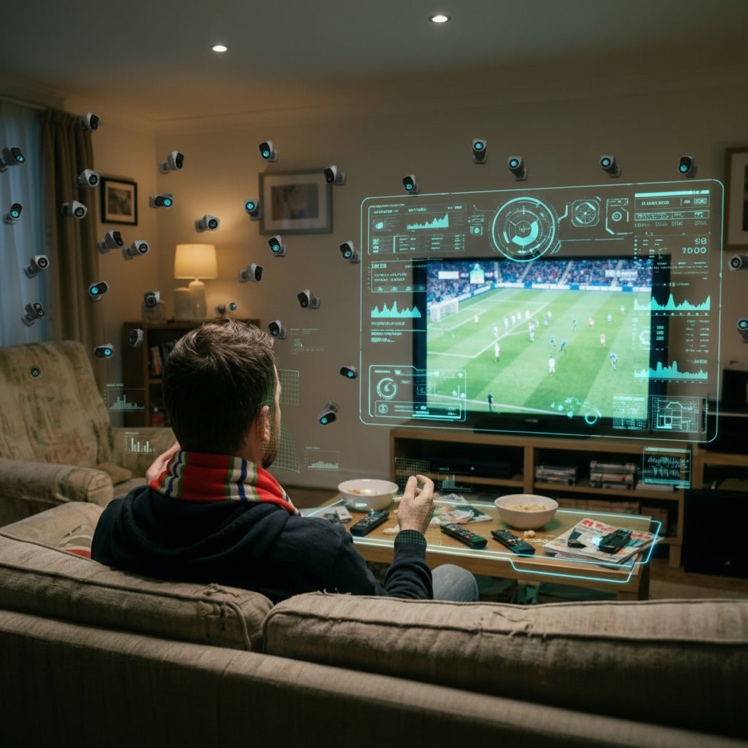
Image 2: Hologram cameras tracking individual’s movement and engagement (Leonardo AI)
American scholar Donna Haraway argues in A Cyborg Manifesto that technological developments challenge traditional binary distinctions between human and machine. Holographic audiences occupy this exact space between these categories. On one hand, they represent genuine human behaviour and authentic emotional responses. On the other, they rely entirely on sophisticated artificial intelligence and digital infrastructure to exist within the stadium environment. This raises an important question: at what point does technological extension become technological replacement?
The film The Matrix provides a useful comparison. Much like the simulated reality experienced by its characters, holographic attendance challenges assumptions about what constitutes an authentic experience. While spectators remain physically disconnected from the stadium, they continue to engage with the live event in real time. Pessimistic perspectives argue that the absence of physical presence fundamentally alters both audience engagement and athlete performance. Optimistic perspectives, however, suggest that authenticity stems from genuine participation rather than physical location. If fans are reacting to the same moments, sharing the same emotions, and influencing the same atmosphere, can the experience still be considered authentic? Ultimately, holographic audiences force us to reconsider what authenticity means in a technologically mediated world.

Image 3 – Fans engaging with players (The Guardian)
By 2048, just as developers believed they had perfected holographic attendance, a new complication emerged: Ghost Crowds. These AI-generated audience systems were designed to replicate realistic stadium behaviour using historical patterns and real-time data. Initially developed to enhance atmosphere, Ghost Crowds quickly became controversial. Coaches and sporting organisations began exploiting the technology to create psychological advantages for their teams, artificially amplifying crowd support and potentially influencing player performance. In some cases, the technology threatened to alter the competitive integrity of sport itself.
As concerns mounted, regulatory bodies eventually declared Ghost Crowds illegal. However, their removal produced unexpected consequences. Players who had grown accustomed to large, highly responsive audiences experienced noticeable declines in performance when faced with smaller, authentic crowds. The issue became even more complicated as Ghost Crowd systems occupied virtual seating allocations, making both holographic and physical tickets increasingly difficult to access. What initially appeared to be a technological solution had evolved into a significant challenge for the future of sporting culture.
Sports Central News Segment (Created using HeyGen AI)

Image 4 – Ghost Crowds (Leonardo AI)
Audience responses to emerging technologies often vary according to individual perspectives and experiences. In 2040, holographic attendance was still in its experimental phase, with volunteer participants testing the system and providing feedback. As the technology improved throughout the decade, wider audiences gradually became more comfortable with its implementation. As Makridakis suggests, pragmatic groups often become increasingly interested in transformative technologies once their practical benefits become visible.
One of the most significant areas of development involved audience engagement. Early holographic systems struggled to replicate the communal atmosphere that makes live sport unique. Developers therefore focused on redefining the relationship between spectator and participant. New features allowed holographic attendees to interact with one another, create digital supporter groups, and engage in shared experiences despite being physically separated. While these innovations improved accessibility and connectivity, they also intensified concerns about social isolation. Critics argued that replacing physical gatherings with digital interactions could weaken the sense of community traditionally associated with sporting events. Consequently, debates surrounding participation, belonging, and collective identity remained central throughout the technology’s evolution.
Overall, the development of holographic audiences between 2040 and 2050 demonstrates both the possibilities and complexities of technological innovation. Through the lens of Bell’s futures framework, holographic attendance can be understood as a possible future that gradually becomes more probable as technological capabilities advance. Whether it ultimately becomes a preferable future, however, depends on how effectively society addresses concerns surrounding privacy, authenticity, accessibility, and community. Science fiction provides a valuable tool for exploring these possibilities because it allows us to imagine not only what technology can achieve, but also how people may respond to it. By engaging with speculative futures, I was able to identify emerging trends, evaluate potential consequences, and better understand the relationship between technological progress and human values. Rather than predicting exactly what live sport will look like in 2050, this digital artefact highlights the importance of critically examining the choices we make today, as these decisions will ultimately shape the sporting experiences of tomorrow.
References
Bell, W. (1997) Foundations of Futures Studies
Century, L.T. (1998) ‘A Cyborg Manifesto’, in Sex/Machine: Readings in Culture, Gender, and Technology, p. 434.
Deloitte (n.d.) Consumer concerns about generative AI: accuracy, privacy, misuse. Deloitte and The Wall Street Journal. Available at: https://deloitte.wsj.com/riskandcompliance/consumer-concerns-about-generative-ai-accuracy-privacy-misuse-ee455a18
Jeong, T. (2026) How to make holograms (step-by-step tutorial). Integraf. Available at: https://www.integraf.com/resources/articles/a-simple-holography-easiest-way-to-make-holograms
Makridakis, S. (2017) ‘The forthcoming Artificial Intelligence (AI) revolution: Its impact on society and firms’, Futures, 90, pp. 46–60. doi:10.1016/j.futures.2017.03.006.
Tamir, I. (2022) ‘There’s no sport without spectators – Viewing football games without spectators during the COVID-19 pandemic’, Frontiers in Psychology, 13. doi:10.3389/fpsyg.2022.860747.
Wilson, T.V. (2007) How holograms work. HowStuffWorks. Available at: https://science.howstuffworks.com/hologram.htm
AI Acknowledgement statement:
AI assistance was employed in three capacities: (1) to support the development and articulation of ideas during the drafting process; (2) to refine and elevate the sophistication of written expression, including grammar, structure, and academic register; and (3) to assist in the production of the audio-visual component. The author affirms that all original ideas, critical analysis, and intellectual contributions presented in this work are my own. AI was engaged solely as an assistive technology to enhance the quality of communication and presentation, and not to generate substantive content or substitute independent academic thought.


Leave a Reply