Prior to studying BCM325, I didn’t have a particular interest in science fiction cinema or a foundational understanding of the genre. My film media exposure has been largely shaped by romantic comedies and dramas, which presented technology in ways that felt positive and easy to understand. My prevailing view was that tangible technology existed to simplify life and enhance our capacity to navigate society. Over the course of BCM325, however, these assumptions were significantly challenged. Rather than accepting technological advancement at face value, I began to consider the broader implications it carries, and the extent to which convenience may obscure more complex social, ethical, and cultural consequences.
My first notable lightbulb moment was during Week 4, Makridakis’ four scenarios provided a valuable theoretical framework through which I analysed Her. As a first-time viewer, I didn’t anticipate the dramatic shift of Theodore’s perspective from optimist to doubter. A turning point for me was his brief interaction with Catherine (who embodies the “doubter” archetype), as it was enough to question Samantha’s authenticity. By invoking shared personal experiences, Catherine exposed a fundamental limitation of artificial intelligence: its inability to authentically engage in personal memories. Released in 2013, Her engaged with ideas that once appeared hypothetical. It is no secret AI has become fluently embedded in modern life; therefore, the plot of relationship complications has become a very possible future trajectory. Could we now be more exposed to this notion of AI becoming a more personal and authentic form of technology.
The Week 7 screening of Ghost in the Shell offered a rich site for theoretical engagement. My initial viewing of Kusanagi’s creation sequence interpreted the water motif as symbolic of human purity, connecting it to Haraway’s cyborg theory and McLuhan’s proposition that individuals are shaped by their environments. However, a response to my discord analysis during the screening redirected my thought process to the idea of being organically cyborg.
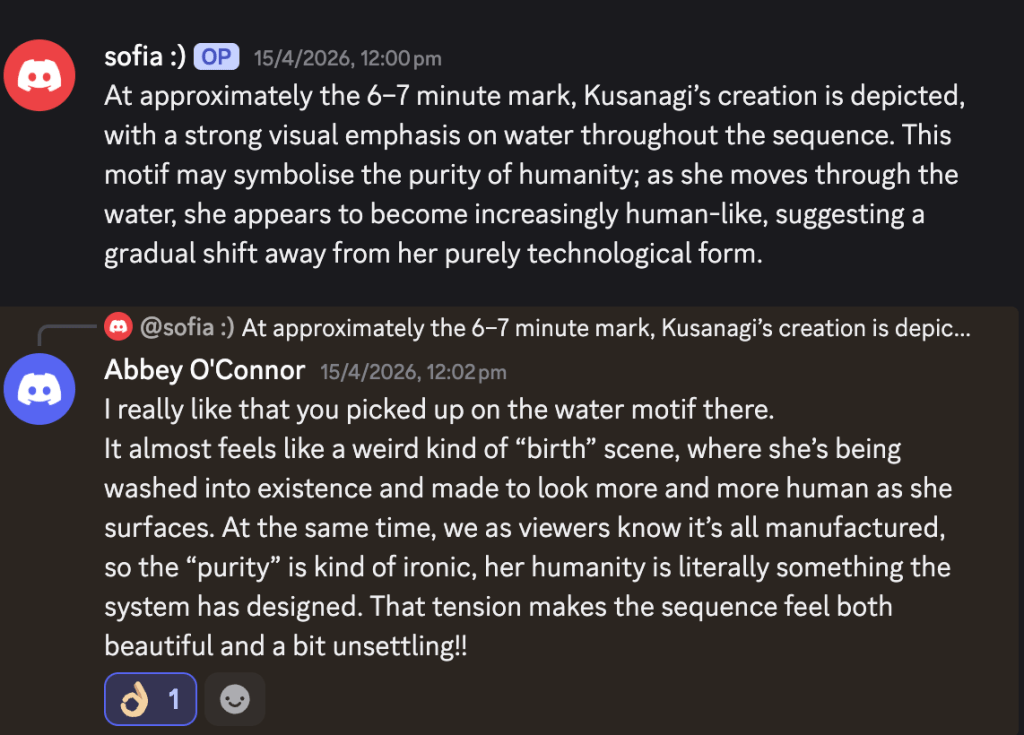
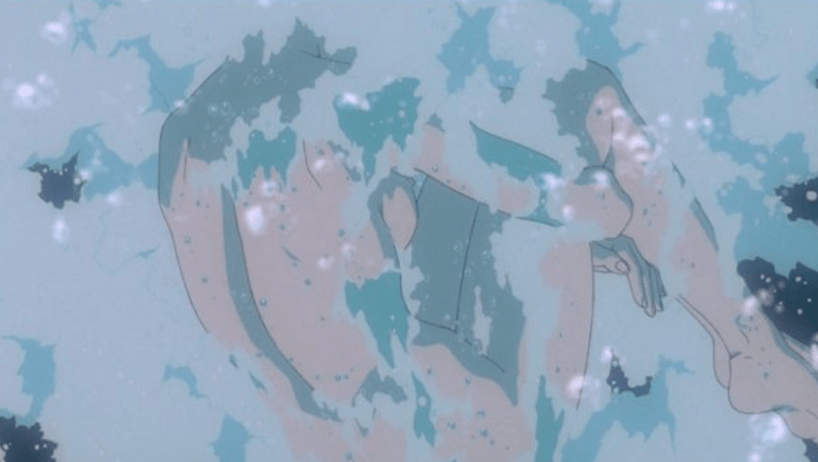
This led me to reconsider Haraway’s framework more critically: rather than functioning as freeing, the boundary-crossing depicted instead exposes how artificially the boundaries were forced initially. The question that remains is whether breaking a boundary that was artificially created truly means you are free, or whether it just proves how much power the system that created it still holds.
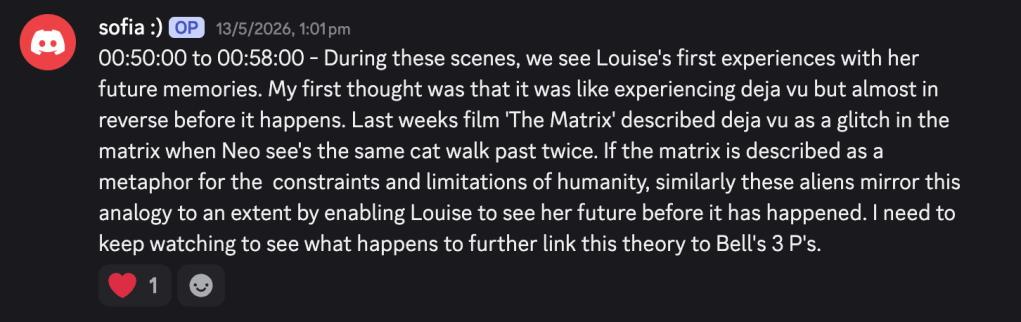
During Arrival I found myself drawing many connections to The Matrix, specifically as Louise began experiencing future memories. The Matrix operates as a metaphor for technological constraints imposed upon humanity. Heptapods in Arrival serve as a liberating force, freeing Louise from the constraints of linear time and broadening her perception into one where past, present, and future exist simultaneously rather than in sequence. My first connection to this movie from my own film viewings was Interstellar, where time is treated as a malleable dimension. This portrayal directly aligns with El-Bizri’s theoretical engagement with mortality, raising questions about how our understanding of death shifts when time is no longer universal.
The link between posthumanism and linguistic relativity is realised most powerfully in Arrival. The Heptapods function as a post humanist archetype as their communication is entirely outside human understanding. I found a relevant parallel with contemporary AI, which similarly operates through its own structural codes, governing how it constructs and communicates meaning. The Sapir-Whorf hypothesis can be applied here: if the Heptapods’ non-linear language enables a non-linear experience of time, the structural logic of code may similarly shape how AI interprets the world. Contemporarily, this can be proven by AI chatbots requiring specific prompt structures for the best outcome. Hence, the framing of an input directly determines the output, suggesting AI is not a neutral processor but a body whose responses are fundamentally mediated by language.
We examined films collectively to explore how technological advancement reshapes identity, communication, consciousness, and power. Initially, I struggled to comprehend cognitive estrangement, however once I realised the connection to the Uncanny my whole perspective changed. My viewing of 2001: A Space Odyssey was marked by genuine disorientation, but in retrospect, I see how this is the effect cognitive estrangement is designed to produce prompting the viewer to interrogate their assumptions about reality and familiarity. Weeks later with the screenings of The Matrix and Ghost in the Shell, environments that once felt overpowering became clear, reflecting my broader insight: that exposure to futures thinking fundamentally alters the way one perceives the unknown.
Now looking back on my assumptions prior to BCM325, I recognise the depth of critical knowledge this subject has given me. Previously, my unknown engagement with Makridakis’ framework was limited by a binary understanding of outcomes. Engaging with the full framework revealed that futures rarely fall into best or worst, the middle ground between best and worst case scenarios is often where reality sits.
The Realities of Human Decision Making was better understood with this website, as it simplified the concepts without taking away any of the theoretical framework ideologies.
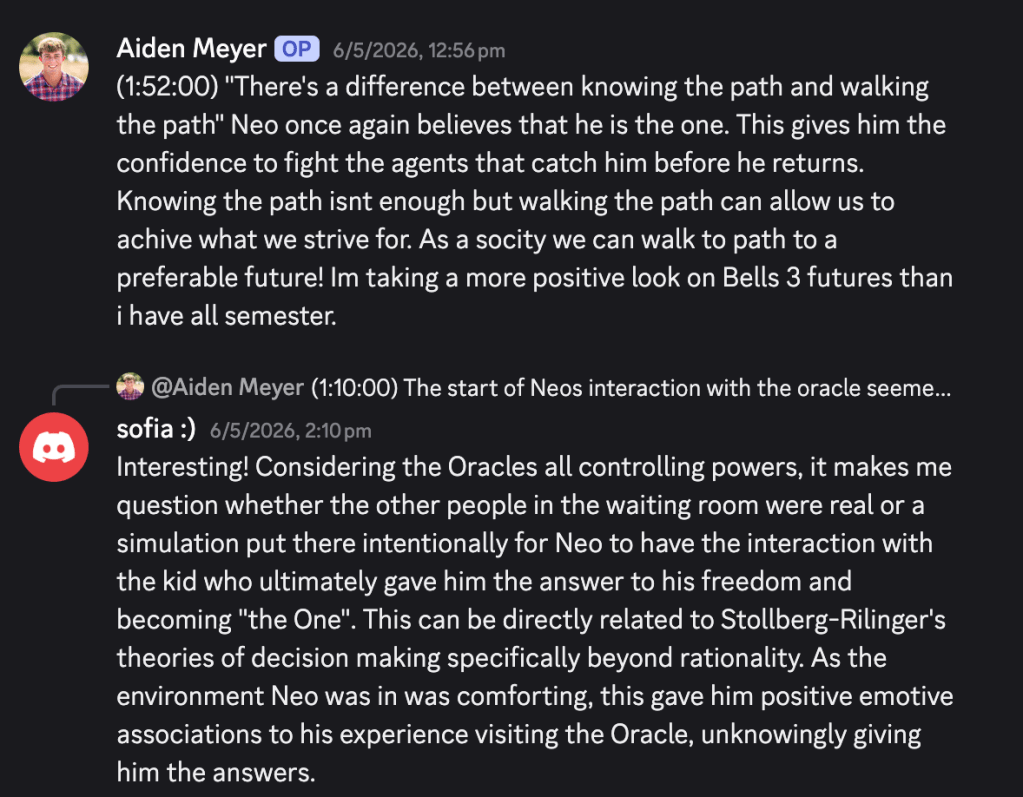
Furthermore, The Matrix especially unsettled my assumptions around bounded rationality and prompted questions I continue to sit with: Do decisions continuously reshape the cybernetic feedback loop? Is this recursive nature what accounts for the cyclical patterns we see throughout history? Beyond BCM325, I anticipate drawing on Wendell Bell’s Three P framework possible, probable, and preferable futures as a structured lens for evaluating my career pathways and all possible outcomes.
-> Click View my presentation to see more
Personally, the most enduring question to emerge from this subject concerns the nature of technology itself: is technology dangerous by nature, or does it evaluate itself by how humans choose to use it? Will the relationship between humans and technology continue to evolve productively, or are we condemned to repeat the outcomes of past decisions? These questions have not been resolved, but equipped me to engage far more critically and thoughtfully than I had ever expected. And I can confidently say I will be watching more science fiction movies in the future.
Youtube video created with HeyGen and Canva
Reference List:
Bell, Wendell. (2002). Making people responsible: The possible, the probable, and the preferable. In James A. Dator (Ed.), Advancing futures: Futures studies in higher education (pp.33-52).
Stollberg-Rilinger, B. (2018). “Decision” in Poli, R. (Ed.) Handbook of Anticipation: Theoretical and Applied Aspects of the Use of Future in Decision Making. Springer
Wall, K.D., 1990. A bounded rationality decision process model. In Dynamic Modelling and Control of National Economies 1989 (pp. 473-478). Pergamon.
Gadinger, F. and Peters, D. (2016) ‘Feedback loops in a world of complexity: a cybernetic approach at the interface of foreign policy analysis and international relations theory’, Cambridge Review of International Affairs, 29(1), pp. 251–269. doi: 10.1080/09557571.2013.872599.
Goel, R. (2024). Bounded Rationality, Bounded Self-Interest: The Realities of Human Decision Patterns. [online] Medium. Available at: https://medium.com/@nudgetobudge/bounded-rationality-bounded-self-interest-the-realities-of-human-decision-patterns-f37b0cf79a99.
Haraway, D.J. (2016). A Cyborg Manifesto. Manifestly Haraway, pp.3–90. doi:https://doi.org/10.5749/minnesota/9780816650477.003.0001.
Makridakis, S. (2017). The Forthcoming Artificial Intelligence (AI) revolution: Its Impact on Society and Firms. Futures, 90(90), pp.46–60. doi:https://doi.org/10.1016/j.futures.2017.03.006.
AI Acknowledgement:
I acknowledge the use of artificial intelligence (AI) tools in the preparation of this assessment. Specifically, I used AI to enhance the sophistication and clarity of my written expression, including the academic tone and structure of my writing. I also used AI to assist in deepening my understanding of complex concepts encountered in scholarly literature, all of which I independently sourced through my own research. Additionally, I used HeyGen, an AI-powered video generation platform, to produce the video component of this assessment. I affirm that all research, critical analysis, and intellectual contributions presented in this work are my own, and that AI was used solely as an assistive tool and did not replace my independent thinking or original inquiry.


Leave a Reply