Veil of Velmora is a role-playing game, involving becoming your chosen character. Players receive a character card with the information about their character traits, secrets, and a power. Players must adhere to this information to allow the narrative to unfold seamlessly. I’ve designed the game to be suitable for beginner to intermediate gamers. The theme of this game involves strategic cooperation between players. Provides exciting mystery and unexpected twists experience. The mechanics of this game reinforce this element of suspense through many secret elements and sudden plot twists.
Set in Velmora castle in the Victorian era, Veil of Velmora is a combination of public domain material and original content. For hundreds of years, the noble houses of Velmora have celebrated the rising of the Blood Moon with the Crimson Ball. The political gathering signifies new beginnings where alliances are renewed, debts are settled, and heirs are announced. Rumours of King Aurelius IV having a serious illness, secret children, cursed bloodlines, and forbidden magic have spread far across the kingdom. Six invited guests received letters instructing them to meet in the billiards room at exactly 11:11pm. Letters were delivered from months prior to the hour before the meeting. The Exiled Prince, The Oracle, The Court Alchemist, The Duchess, The Royal Executioner, and The Archivist.
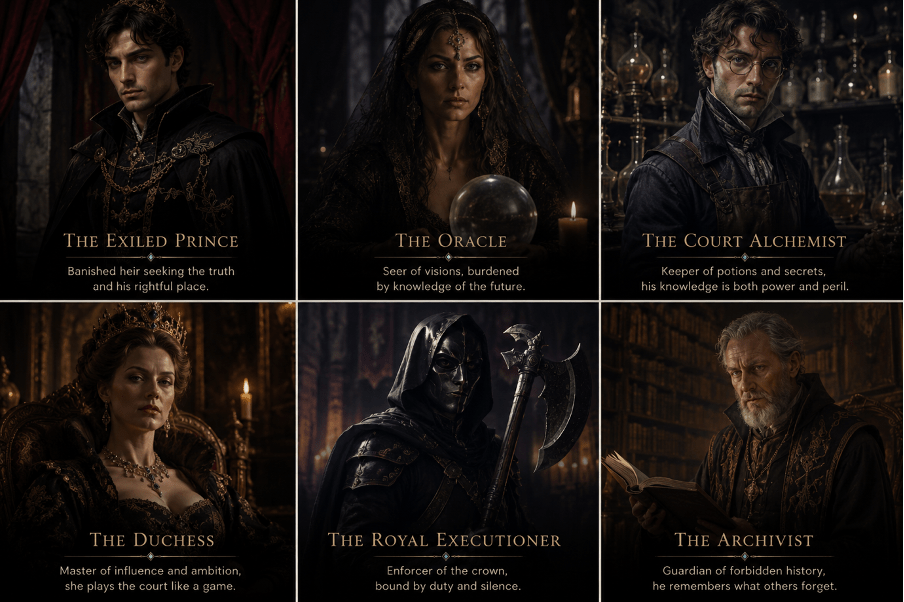
World Building
The world of Velmora slightly bends the rules of Alethic value by setting this game in a mostly comprehensible world with the inclusion of some fantasy elements. Velmora is situated in the primary world, in the past (Victorian era) however, it incorporates some magic elements such as witches and fairies. I decided to include these magical elements to make the gameplay more interesting and unexpected, compared to other murder mystery style games I have come across which seem to be a bit more predictable. There is a supernatural element in this world with the introduction of witches and fairies, augmenting the natural species of the actual world. I decided to set Veil of Velmora in Victorian Era Europe as it was a time of rapid social and industrial change, leading to lots of complexities in imperial power which provides the backstory of this game. Its strict moral codes and extreme class disparities have also been noted and included as an important feature to character role-play in gameplay. Logic is occasionally violated in this game as Velmora bends the rules of logic with its fantastical elements including witches and fairies and incorporates their magic powers.
Key Game Mechanics
Veil of Velmora includes many mechanic systems for players to interact with other players and the gameplay. The underlying mechanics in this game include investigating the information provided, interpreting what’s reliable, influencing the social table, concealing secrets and hidden roles, and risky accusations. Taking a turn in this game can look drastically different for each player depending on the development of the game and your individual character card. For this game, a series of actions is required for each turn which differ depending on how far into the game you are. For example, in Phase 1, a player must draw a memory card which is kept a secret until they decide to reveal it to support their version of how the Kings death occurred. A player can trick other players by making a poker face when drawing their card from the deck to put off their opponents. Additionally, this player has the House Vesper mask power, enabling them to rewrite any revealed memory to their advantage. In the previous turn, Player 2 revealed they found a smashed mirror in the Kings dressing room. Player 1 could create an alliance with player 2 by saying they saw the same thing, or they could accuse Player 2 of purposefully smashing the mirror to make it look like the King had an angry rage. If the other players believe this theory, Player 1 receives influence tokens. This example shows how players must be creative and strategic when taking their turn. As players all play different characters, this creates direct asymmetry where players take different actions depending on their role. This game includes multiple decks of cards, each deck having a different purpose. Cards mostly add context and influence counterplay in this game by being very connected to each other.
More Information about Mechanics and game play here! https://youtu.be/spr6mMhGbZY
Core Game Loop and Three-Act Structure
Players uncover fragments of the night, reinterpret them to support their version of events, influence others through social actions, react to shifting alliances, and build political power until the final court judgment.
On the strike of 11:11pm, right before their very eyes, the King collapses in the centre of the room. The door slams shut, windows slam closed, there is no way out now. Who has the most influential alibi? One player will generate the answer as to how and why the King died on the mobile app, including the number of characters playing Each player begins by taking a turn drawing a card from the deck which they will then interpret and creatively decide how to play based on their character and their vulnerability. I am still figuring out the logistics if players should be dealt 2-3 cards to start building their storyline which I can experiment with in the next couple of weeks. If other players believe their theory, they receive influence tokens but if they disagree with their statement, they can have tokens taken from them.
Final Thoughts
Overall, Veil of Velmora reflects many of my personal interests in its theme and also gameplay experience. As a beginner gamer, I find the design of a game crucial to my interpretation of its difficulty. Additionally, as the Murder Mystery genre increases in popularity, I hope people will take a liking to this type of creative role-playing game.
Boardgamegeek n.d., BoardGameGeek | Gaming Unplugged Since 2000, boardgamegeek.com.
BCM 300 Lectures weeks 2-5
This Blog post has also made use of Gen AI for images, and game prototyping.


Leave a Reply