Imagine in 14 years from now attending a live sports game virtually from your living room, it may seem like a stretch however it’s a possible future direction. Live sport was a big part of my upbringing, attending many games of all kinds of sport from local to international. Throughout my 21 years of live sport exposure, I have noticed many changes from rule adjustments to viewing options. Sport will keep changing and adpating to future trends and technological advancements making it easier for audiences to engage with their interests. By 2040, I believe sport will have more fan acknowledgment and align their values more with the community. Using Wendell Bell’s views of futuristic views, this blog will dive into the Possible, Probable and Preferable pathways in 2040.
Live Hologram Attendance (Possible)
The Science Fiction (SF) genre is known for its ability to exhibit mind-altering novums which test current epistemic limits. Holograms have been a popular recurring novum in many SF movies since its introduction in 1956 in the film Forbidden Planet. Holograms were an extremely unrealistic and futuristic reality in the 50s, however as technology has evolved and audiences get used to the idea of seeing holograms in films, they are becoming a more realistic possibility.

Fig. 1.1 – Live holograms attending live AFL match (Chat GPT)

Fig 1.2 – Home view of hologram AFL match (Chat GPT)
Live individual holograms allows fans to attend matches and involve in the crowd atmosphere at sporting events from their location. Individuals have their hologram projected onto a reserved seat at the game allowing audience members to see and interact with them. Fig 1.1 represents what this vision would look like from an audience member at the sports stadium, whereas Fig 1.2 depicts what the hologrammed individual would see from their location. This possible future novum tests logical and mathematical limits and employs foreign technology becoming an altered reality with unknown consequences despite its extensive representation in SF. Without a thorough knowledge of this technology, glitching and malfunctioning holograms would be a common occurance creating chaotic unpredictability and distractions for the players and fans. Additionally, other industries could adopt the idea (such as health facilities), leading to a loss of human connection and care. However, it could present new opportunities for individuals with physical limitations, by being able to attend games and experience a live stadium environment and sense of community and inclusion.
Higher technological involvement in Live Sport (Probable)
From gladiatorial games in ancient Rome to the FIFA World Cup, live sport has always been driven by audiences. Since streaming services emerged in Australia around 2015, fans have increasingly watched matches online. A 2019 report by the Australian Sports Commission highlights how Kayo Sports gained over one million subscribers in its first year, reflecting this shift. As audiences fragment, streaming platforms are set to dominate the market. In 2040, it won’t be uncommon for more audiences to connect virtually via online viewing.
Melbourne based company Catapult revolutionised sports technology, pioneering wearable GPS trackers for athletes. They measure metrics such as speed, positional data, acceleration and more. A study conducted from 2000 to 2017 by the National Library of Medicine in America discovered the importance of these devices to meet the rising demand of team training improvements and to observe the internal and external trends of individual player performances. However, they also mention the restricted utility of these devices in areas with limited satellite coverage including indoor sports as most data recorded is from outdoor sports including AFL. Fig 2.1 displays data recorded from GPS trackers, however not all aspects of this specific study have been recorded revealing a gap in these studies. Fig 2.2 shows later recorded data in 2016 revealing more data recorded, leading to an improvement in GPS tracker’s capabilities.
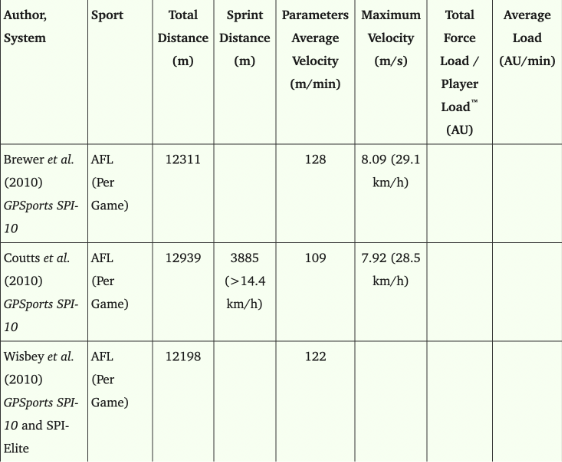
Fig 2.1 – Summary of Studies using GPS and Inertial Monitors.

Fig 2.2 – Summary of Studies using GPS and Inertial Monitors.
As this study was conducted in 2017 and established in 2020, it does not take into account more recent technological advancements on these devices, however it provides a trending improvement of this technology in 20 years. From looking at this data we can predict that by 2040, GPS trackers will have significantly improved accuracy, standardisation, and increased availability to fans. This could look like real-time data of player statistics on mobile apps such as AFL Live. Fig 2.3 below illustrates a probable 2040 future where live sport is enhanced through real-time performance data, allowing fans to access detailed player insights instantly through immersive mobile interfaces. It reflects the shift toward data-driven fan engagement, where spectators interact with athletes not just visually, but through continuous streams of personalised performance analytics.
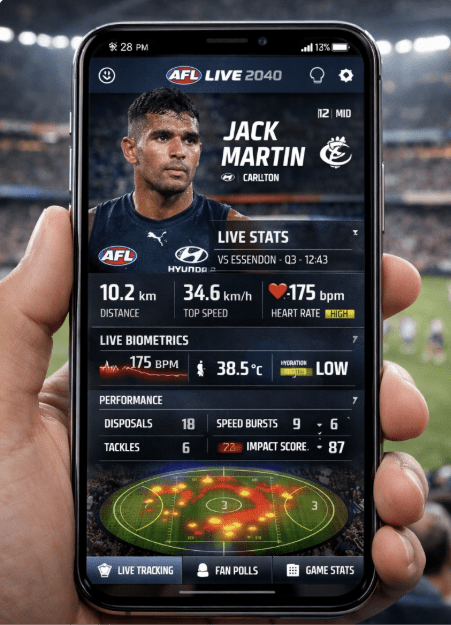
Fig 2.3 – Real-time player analytics in the AFL Live app in 2040 (Chat GPT)
What the community really wants for 2040 (Preferable)
Benedict Anderson’s theories suggest that community identity is based on a shared belief or perception of a nation. Considering the current happenings, communities can agree that live sports games are rapidly becoming less accessible to communities as ticket prices surge and availability becomes limited. Recently, AFL scheduling has seen lower-ranked teams with smaller fan bases receive prime-time fixtures, prompting social media backlash over limited ticket access and inconvenient match times. AFL fixtures are scheduled four months in advance, therefore the unpredictable nature of team rankings each for the current season has no influence on the organisation of matches. As this is something that takes a long time to organise, I believe fans in 2040 would prefer a more flexible time tabling schedule which allows for game scheduling to be changed during the season. Realistically, it would have to be scheduled few weeks in advance, however I believe this would benefit ticket sales and fan engagement at games. However, this would impact the players as teams have scheduled training sessions and commitments outside of sport.
Additionally, ticket prices are exceedingly and unnecessarily high leading to many fans opting to online viewing. Considering the current economic landscape of Australia, I think audiences can agree that some standardisation should be put in place to make games more accessible. The AFL specifically have not addressed this issue leading to communities feeling unacknowledged and being less likely to support the game. With the cost of living expected to continue rising, I believe sporting cooperations should acknowledge this and lower costs of ticket prices and merchandise. To support this by 2040, the government could step in and apply pricing caps on ticket pricing. Another possible initiative could be each week having one local community attend a game for free or at a discounted rate. For example in AFL, a Sydney Swans home game could grant the Sutherland Shire discounted tickets for a round. Not only would this increase fan attendance at games, but it would also grow fan bases as people who may not be particularly interested in AFL could inherit an appreciation for the game and continue to support their team. Fig 3.1 shows a visual example of what this could look like.

Fig 3.1 – Sydney Swans discounted council tickets (CoPilot)
Final thoughts
Looking toward 2040, the future of live sport sits at the intersection of technology, accessibility and community values. While possible futures such as live hologram attendance push the boundaries of imagination, probable developments like advanced data integration are already reshaping how fans engage with sport. However, the preferable future prioritises inclusivity, affordability and genuine community connection. As sport continues to evolve, technological innovation must not come at the expense of human experience. By aligning futuristic advancements with community needs, live sport in 2040 has the potential to remain a powerful social connector rather than a privilege reserved for a few.
AI Usage and Acknowledgement
This assignment utilised artificial intelligence tools (specifically ChatGPT, Copilot, and Notebook LM) to support the development and refinement of ideas. AI was used to assist with summarising academic sources, generating initial concepts related to future trends in live sport, and improving the clarity and structure of written expression. All outputs were critically reviewed, edited, and adapted to align with the assignment requirements and my own understanding of the topic. No content generated by AI was submitted without modification, and all final work reflects my independent analysis and interpretation.
Fig 1.1 prompt: generate me an image of a futuristic AFL game, audience members holograms. Use warm stadium lighting.
Fig 1.2 prompt: generate me another hyper realistic image of a person sitting in their living room being surrounded by a hologram of an afl match, as if he was actually at the game.
Fig 2.3 prompt: generate me a hyper realistic photo of a player profile on the afl live app in 2040 showing live statistics on a player profile.
Fig 3.1 prompt: generate me an image of an AFL sydney swans games schedule and include a heavily discounted rate for each council area of sydney home game.
Reference list
Bell, W. (2001). Futures studies comes of age: twenty-five years after The limits to growth. Futures, 33(1), pp.63–76. doi:https://doi.org/10.1016/s0016-3287(00)00054-9.
Catapult (n.d.). About Catapult. [online] Catapult. Available at: https://www.catapult.com/company/about-catapult.
Flohr, M. (2023). Benedict Anderson’s Imagined Communities. [online] Critical Legal Thinking. Available at: https://criticallegalthinking.com/2023/04/25/benedict-andersons-imagined-communities/.
Hutchins, B., Li, B. and Rowe, D. (2019). Over-the-top sport: live streaming services, changing coverage rights markets and the growth of media sport portals. Media, Culture & Society, 41(7), pp.975–994. doi:https://doi.org/10.1177/0163443719857623.
Imagining the Digital Future Center. (2024). ‘AI Impact by 2040’: Deep thinkers address the potential future – Imagining the Digital Future Center. [online] Available at: https://imaginingthedigitalfuture.org/reports-and-publications/the-impact-of-artificial-intelligence-by-2040/deep-thinkers-address-the-potential-future/.
Klimchynskaya, A. (2020). SFRA sfrareview.org VOLUME 50 : ISSUE 4 : FALL 2020. pp.69–72.
Mediaweek.com.au. (2026). Gen Z Sports Trends: How to Win the Most Influential Fans. [online] Available at: https://www.mediaweek.com.au/gen-z-sports-trends-consumption-research-2026/.
O M P A N Y P R O F I L E, C. (n.d.). IBISWORLD.COM 03 9655 3881 INFO@IBISWORLD.COM.
The Future of Australian Sport Megatrends shaping the sport sector over the coming decades Second report. (2022).
Theodoropoulos, J.S., Bettle, J. and Kosy, J.D. (2020). The use of GPS and inertial devices for player monitoring in team sports: A review of current and future applications. Orthopedic Reviews, [online] 12(1). doi:https://doi.org/10.4081/or.2020.7863.
 SofiaUnplugged
Leave a comment